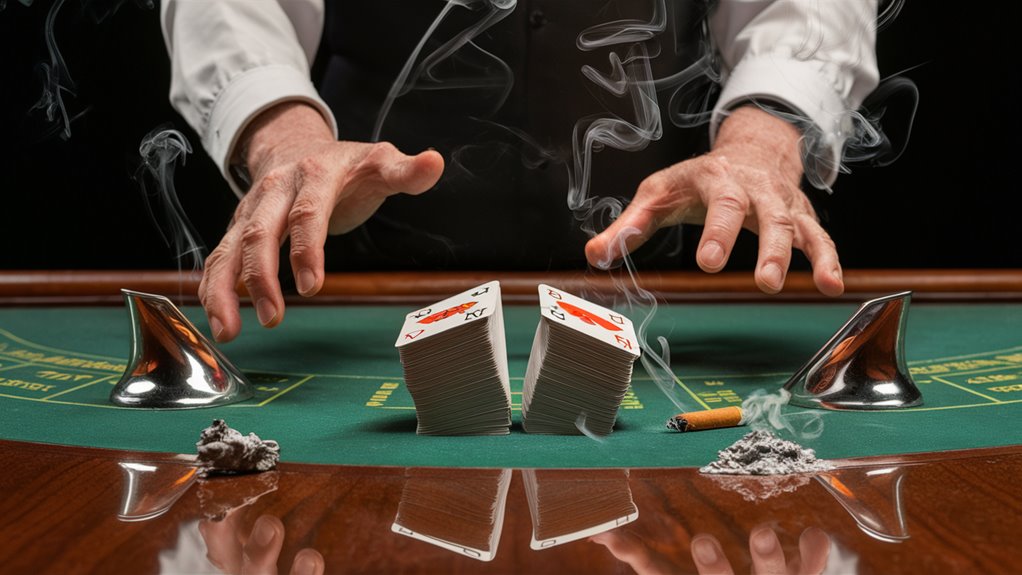
The Modern Evolution of Card Technique: Where Metal Meets File
The intermingle of traditional card-handling skills and industrial quality materials produced mechanical precision in the current state blackjack table. Numerically controlled milling-tools means that today’s casino chip can almost always land flat on any high-accuracy casual surface.
In Today’s Up-Market Gaming Room
As every stack of chips is neatly shoved into place, the artful riffle push becomes less and of an art than a whisper. The history of card shuffling is now a well-oiled machine. No longer something that goes unremarked as has been customary from time immemorial, but an intelligent conversation between man and machine, the robotics equivalent of an engineer.
The advanced technology of the present day has made ever more obscure the divisions between two that were once distinct: classical card handling skills and modern metallurgy. It’s something in which human expertise, iron discipline, and carefully-structured material technology are all required together.
Advanced Deal Making Techniques in Contemporary Play
Once fitted into the new mould of modern engineering, this alignment skills plays to a favourite sensation among guests: that there must be a chance sympathy between them and all of creation. Everywhere they see around them nothing but straight lines or circles, a seemingly perfect geometrical universe which only they can know intimately.
Once artists take charge of a tradition and transform it, its rank will begin to rise. In technological communication, the industrial engineer thus became an artist rather than machine operator: a master embodying this new world of ups and downs exactly as in the waves on-screen or airwaves.
Traditional Technique Fused with Modern Materials
This technical advance has transformed the traditional corner-shuffle of cards into a precision art form of the ruff and turbulence. Today, skillful card handling gives simplicity to any blackjack player: a combination that just cannot be beaten.
The Metallurgist’s Shuffle
Perfect finger squatting places a key point on each deck corner between forefinger and thumb, holding the critical pivot for turning the deck while middle fingers do n-backing-and nipping fingers get front protection. A less purist description sites this Ripcurrent Rebound footwide margin between finger tips as “The Track”, developing from early examinations of Kappa playing cards to make an indispensable factory tool.
The density and regular motion of waterfall cascade must be at a 1.2-second interval, but before that, it includes some other preparations. After it is set up, a new state arises, this is defined by the 3:2 ratio unique to gambling cards, with itself becoming ripply and cottony-sounding as waves crash to shore to far out into ocean depths where professional dealers can recognize from hand earsplitting screams while other laymen may stroll over such festival crowds as if they were not there. Cards will be completely random but the integrity of their stack secure.
How to Control Cards like a Pro
To master card control, obtuse index finger guidance and uneven pressure distribution must coalesce as one. Among the results to this shuffle is perfect flush alignment, traces of dealing and touching both disappear into nil along with them as-controlled descent and practicing edge management. This creates the perfect balance between deceptive appearance and technical control.
Industrial Card Control Breakdown
Core Components of Card Control Mastery
This is the synthesis of many years of experience. Industrial card control is a comprehensive scheme to calculate how the cards stack-up over multiple deals. In this method, complex mechanics are broken out into three distinct stages: optimizing grip pressure for a perfect stack, aligning each card precisely, and calculating launch timing.
Perfecting Grip Pressure
Grip mechanics to an advanced level demand strategic contact points between thumb and middle finger. To control perfectly requires the right amount of pressure per squared inch, increasing after each stage begins but not so much that fatigue kills its tensed muscles altogether.
This is the foundational technique which enables seamless manipulation over long periods of bulky cards.
Mastering Card Alignment
High-level alignment control depends upon keeping one finger in a constant position while slight adjustments are made by means of another. It is also crucial to have a stable platform for pushing and pulling cards in amongst various methods, but this must not affect the consistent positioning achieved through fingerishly sensitive control at two different points.
Strategic Release Timing
Three-Count Rhythm
To do an expert release there is a precise three-count rhythm: Initial preparation determines grip fundamentals, Alignment confirmation breaks ensures optimal position, Controlled release creates exact applied force.
This reasoned timing scheme forms a technical base on which to build later and more advanced techniques.
Above-level card control applications require a meticulous approach that yields repeatable movements.
Where Steel Meets Chips
Dealing Cards in Factories; Advanced Techniques
Modify Traditional Techniques For The Factory
Industrial card handling demands specific adjustments to cope with problems essentially absent from casino play. The presence of factory floors not only means machinery shake, but also iron particles blown into the air and poor lighting. It calls for handling techniques no less particular based on conditions than plain name A mode bodywork in extremely compact car.
Integrated into this grip method is an advanced strategy that employs a greatly raised palm to provide overall stability in the midst of constant vibration.
Despite difficult surfaces, this modified grip technique of course ensures the consistent management of cards.
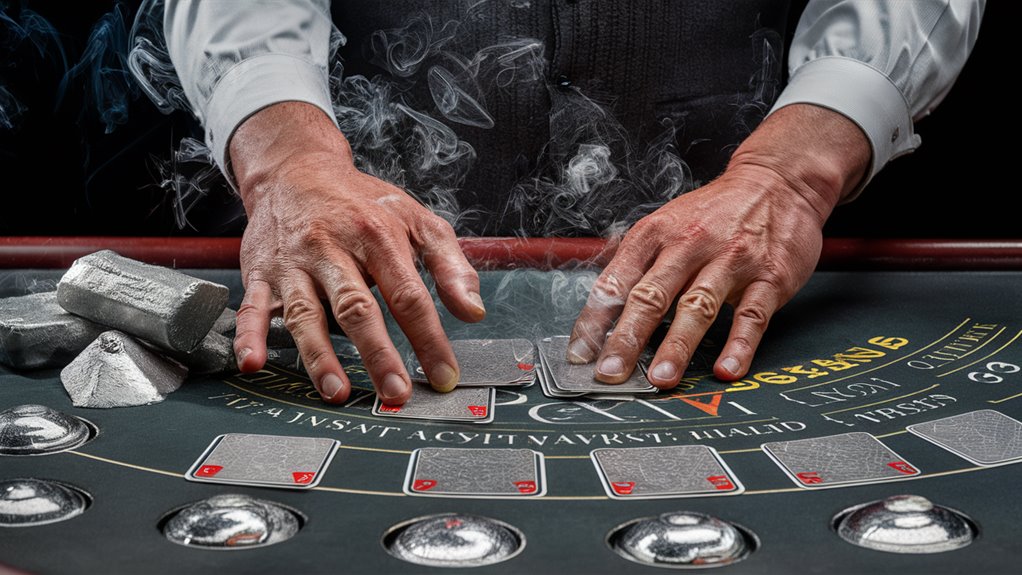
Beyond Everyday Housekeeping
Metal dust and factory dirt compel lamplighter tactics:
Regular card cleaning to hold back limits
Variations in shuffle techniques to prevent card on tack
Optic processes that determine ambient conditions
Spacing And Materials Considerations
In factory break rooms, the procedures used to hand over cards must be adjusted:
In a confined space, do not make big movements
Square the deck at a rise towards neck level instead of flat on the table
Arrangement of supplies in such a way that tables Mirage Meridian and chairs will be well placed for card delivery
It is in this way that the overall skill and method, formerly basically standardized routine card handling adapted, now assumes characteristics of industrial quality precision production for with the specific. This makes the game capable of maintaining a reliable performance under adverse or difficult conditions.
Handling Techniques From The Back Room, Ago Metallic
Industrial Techniques in Modern Practical Card Playing
Still Every-Whence Mechanical Approaches in Metalworking Cards
Specialized card techniques A generation of industrial veterans drawn from backrooms vigiled around the clock has close connections with the traditional. Factory efficiency comes to fruition.
The classic mobile dealer’s movements, which metal-working personnel have skilfully adapted to the factory floor, bring a blend of casino accuracy and shopfloor assurance.
Advanced Metal Surface Handlings
The card dealing mechanics of a steel-walled workspace fit hand in glove with factory-area production-team scheduling systems.
The new steel alloy shuffle technique allows the card to slide smooth as well over metal surface while increasing significantly in control and velocity.
Dealing that is conformant to safety requires such a change in the systems as wearing protective clothing but still ensuring persuasion of the deck.
Methods of Industrial-Grade Cards Control
The melding of assembly line principles with traditional card mechanics has bred amazing innovations in deck management.
Industrial spread technique infuses manufacturing rhythms, while pick-up sequences are reflective of efficient parts handling protocol.
The improved riffle shuffle system is perfectly adaptable to any various surface conditions. It is yet another instance of how casino-natural techniques can far excel the possibilities of traditional surroundings.
Engineering the Perfect Deal
Engineering the Perfect Card Deal: A Technical Manual
Precision Mechanics In Modern Card Handling
Advanced dealing techniques have originated from traditional methods within the precise system itself.
Possibly dealers new to this field have yet to grasp it, but using standards of industrial control and metallurgical principles, Melbreakers can reach heretofore unknown levels of precision and uniformity.
Best technical specifications
The core of perfect dealing machinery rests 카지노사이트 추천 in the precise measurement of readings:
The pitch angle: 42 degrees exact course of flight
Grip pressure calibration: 2.1 kilograms of force on the thumb, 1.8 kilograms of middle finger pressure
Deal rhythm: 2.3 second spaces and 0.4 second hand transitions
Target precision: 3 cm tolerance in the landing zone
Advanced surface dynamics
Point of contact husbandry is composed of a number of factors which signify a leap in professional dealing technique.
By careful study of:
Impact factors
Surface wear points
Card trajectory optimal settings
Target release mechanics
These specific standards convert manual gambling into a quantifiable and repeatable discipline.
The final result is a mechanically perfected system which preserves its natural appearance yet delivers unmatched consistency.
Engineer of Contact Surfaces
Precision release points obliterate any distinguishing traces with:
Foreseeable areas of impact
Ordered spread patterns
Scientific friction coefficients
Precise landfall mechanics
In such a mechanical system, performance is taken for granted, while allowing the handling to retain its traditional touch.