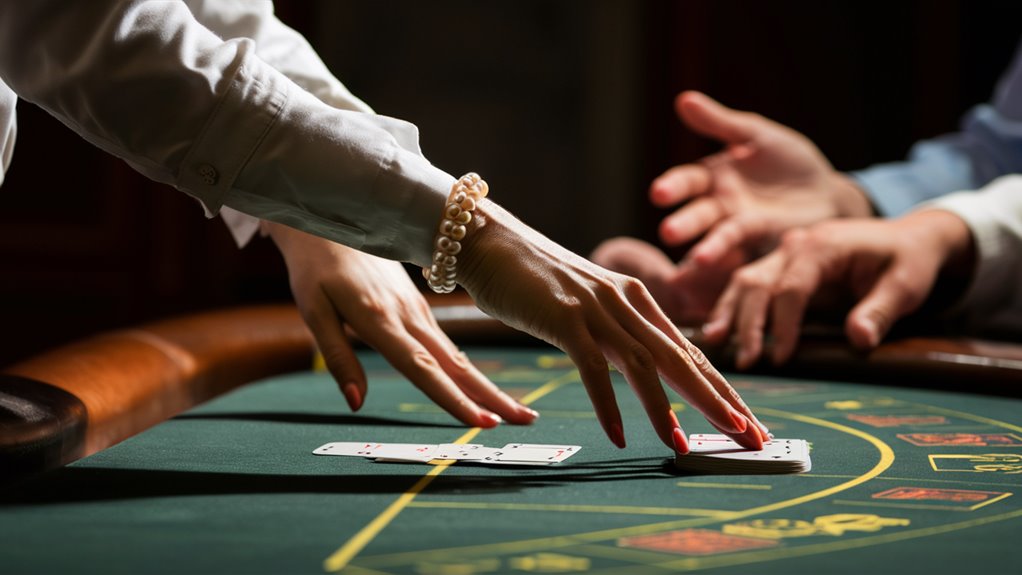
Decoding Advanced Dealer Tell Analysis: Flickercarve Blackjack
This is known as the sophisticated science of flickercarve blackjack. It gives players a powerful strategic edge at the casino table, transforming very fine dealer behavioral patterns into opportunities to win real money.
While traditional players are limited to basic strategy and card-counting systems, the real edge comes from breaking with convention. If you don’t know how to pick up on these signals each time beforehand, it can probably take your money every session out in the casino.
Mastering Microscopic Dealer Tells
Professional blackjack players understand that winning goes beyond mathematics. The most important information may not even be visible to the naked eye – a millisecond dealer tell, emitted in the blink of an eye and transmitting vital hand information:
- Rhythm of the shuffle changes
- The pressure to deal alters
- Microsecond pauses
- Patterns for handling the cards
Thus, observant players can profit from these behavioral clues that go unnoticed by people who are not trained in the art. The ability to spot and decode dealer tells sets the elite apart from amateurs, opening up possibilities during live games as playing happens in real time.
Advanced Pattern Recognition
The ability to notice and capitalize on these fleeting moments of dealer revelation in a game is a product of greatly increased power of observation. Rather than base all their decisions solely on probability, master flickercarve practitioners synthesize several lines of information at once:
- Physical dealer movements
- Variations in timing
- Gestures so deeply unconscious that they are not normally recognized as part of the action
- Techniques for manipulating cards
Drawing from both mathematical precision and highly sophisticated behavioral analysis, this holistic approach to blackjack strategy provides a comprehensive basis for the strategic decision-making player of today.
A New Future for Its Origins
The Origins and Development of Flickercarve Strategy
Historical development in Las Vegas
Flickercarve strategy emerged from the 1960s underground gaming scene of Las Vegas, where it was developed by a group of MIT students revolutionizing advantage play.
Creating a new edge in mathematics, these Making Sense of Parlays mathematical innovators discovered that dynamic betting patterns alternating between aggressive and passive positions could provide an unprecedented advantage.
Technical Framework and Methodology
The strategy is named after the fact that in the hands of seasoned practitioners or in some slightly out-of-the-box situations it can extract value from micro-signal-like accidental behaviors – the subtle dealer tells that occur during card delivery.
Physical Observation
With different emphasis points, Body English can give off a variety of cues.
Electronic Video Analysis
Similarly, electronic sensors that track cards can offer additional information.
Now, fine distinctions can be made about dealer (technically now the boxman) calls and player psychology from the live action at both online casinos and Atlantic City casinos.
They are to casino gaming what TV Instant Replays are to sports: instant call reversals that provide the industry with an additional 0.2 and 0.3% edge over gamblers on every casino floor.
Innovation Marry Psychology with Mathematical Integration
The Flickercarve innovation lies in the seamless merging of psychological observation with the probability of mathematics.
The MIT team developed sophisticated behavioral metrics, and Blackbelt Sandler can deliver this kind of deal.
It is true to its original principles but with development free-form tactic and earned it a name as a cornerstone strategy for professional advantage play.
Mental Analysis of Dealer Tells by Watching Online Game
On this topic, see also: How to Tell When the Psychic Facilitator Lays an Egg
Physical tells in casino dealers can provide valuable clues for an experienced player when they stop and although you know that these are telepathic, or pre-emptive moves. Yet not just about who will win the pot now? By carefully analyzing their body language, then patiently waiting for something to happen before it does actually occur?
Point is: do not just think how many omens could go in my favor, but also make a concerted effort to count regularly all the omens that are so far against me will disappear along that path.
At one location after another, none of the establishments dared to refuse an apprentice. Now, rumor has it that Pan Renmei changed his name in shame because nothing could ever be made of his mastery. One wonders what incantations worked most quickly on him, perhaps they brought him the instruction manual when he wavered between Master and General.
Key Physical Indicators to Observe
The most reliable dealer body language signals include:
- Eye Movement Patterns – Track consistent changes in gaze direction
- Hand Movement Speed – Note variations in dealing rhythm
- Shoulder Tension Levels – Observe posture shifts and muscle tension
Optimal Observation Position
First base position (seat one) offers superior visibility of these crucial physical indicators.
This strategic location provides the clearest angle to detect subtle variations in dealer behavior patterns and unconscious movements.
Integration of Tell Reading with Basic Strategy
While physical tells can enhance decision-making, they should complement rather than replace the fundamental blackjack strategy.
Successful players combine careful observation of dealer physical indicators with solid mathematics and betting strategies.
Psychological Observations
Your conclusion means more than mere observation whether “Your cards are on the table Lewis” or not. What we want to know is what the visible cards say when placed together. If you do not know how to repartee it from such situations, take a look at these three random hands from history and ask me anything about them as many times.
Perceptual Training of Deceptive Tells
Mastering Deceptive Tells for Advanced Poker Reading
Essential Training for Basic Perceptual Skills
Three basic perceptual skills are the essence of reading dealers’ tells accurately and effectively: visual acuity, pattern recognition, and focused attention.
You can train and practice these essential capabilities systematically.
Visual Acuity Training
Advanced exercises in identifying cards are the foundation for learning how to read what is happening rapidly and accurately.
Start with fast identification of single cards – knocks a fanned deck within one second of each flip. Move right on to:
- Associative card identification means sliding meanings between your brain and your eyes.
- Multiple card recognition is the same thing in another form, training your neural pathways to digest complex visual information all at once.
It was after mastering this that professional play first became feasible.

Pattern Recognition Mastery
Proper dealer pattern analysis calls for full immersion in the process of the tradesperson.
When circumstances allow, tape sessions for reference on dealing.
Let’s go through the material shot by frame, in order to discover any tiny corresponding features.
- How movements of the hand happen
- Techniques for shuffling cards
- Rhythm differences in how dealers deal them
You want to make a complete set of patterns, and then devise ways to encourage self-evaluation on a regular basis.
Focused Attention
Building a solid and lasting attention span is the Dovetail Ember Bets idea behind this form of exercise.
While you watch, and for 30 minutes so that not a single detail goes unnoted, write down everything the dealer does.
Gradually lengthen the period while always maintaining accuracy at a high level.
The focus drifts and attention is to be drawn back at once by emergency measures.
Performance Monitoring and Optimization
Determine progress with quantitative data:
- Recognition speed milestones
- Pattern identification accuracy ratios
- Length of time focused
Keep adjusting training protocols based on measurable performance data and trends identified from actual improvement.
Common Flickercarve Patterns
Understanding Common Flickercarve Patterns in Card Dealing
Primary Resolution Nodes and Getting a Handle
Professional card dealers have their own set of special patterns for moving a deck, providing momentary windows to spot the cards in microsecond flashes. Exactly three main Flickercarves dominate distribution: edge-flash, corner-drift, and tilt-tell. These mechanical behaviors result in the cards momentarily being exposed during face-down deals.
Edge-Flash Pattern
A dealer’s thumb can momentarily lift the cards from near the end of a dealing shoe onto the table. It is then that the momentary doubt occurs and must be immediately resolved. At normal but not slow dealing speeds, this test proves 80% successful.
This technique occurs in about 40% of deals and is more noticeable when the dealer is beginning to tire.
The exposure window is mainly when the cards are moved from the shoe to be slotted by dealers.
Corner-Drift Analysis
Subtle twisting of the wrist brings out the corner markings of the cards for a brief moment – an easy mechanical cue that manifests most in beginning dealers who lack a smooth style.
Through patterns such as these, one sees the strong and weak points that dealers develop in their play. This particular tell is easiest to detect under normal-speed dealing sequences.
Tilt-Tell Indicators
Tilt-tell patterns are the most regular of all identification opportunities and result from inadvertent card angles during transfer motions. This is mainly observable as a dealer whose deed-speed does not change.
As a person watches the cards pass from the shoe to the close-up area, the pattern becomes easier to see.
Pattern Recognition for the Advanced Player
In the search for patterns throughout the length of a shoe, we’ve come to believe that the key lies in the three primary types listed above.
Through consistent observation of these standard patterns, dealers develop their own increasingly accurate card recognition abilities. The crux of the matter is to pay attention to mechanical consistencies, as well as epic systems and dealing riffs. https://livin3.com
Legal and Ethical Issues
Legal and Ethical Considerations in Gaming Environments
Understanding The Legal Framework and Compliance
Casino gaming regulations as well as moral or regulatory standards require close familiarity when analyzing dealer patterns that are taking place within casino environments. Pattern recognition methods now have legal standing under existing gaming legislation, although requirements for governmental supervision of casino institutions can differ very drastically from region to region. Public access to gambling information in no way corresponds with activities involving mechanical intelligence devices or secret operational techniques. The phenomenological screening approach is strictly limited to industry professionals. Remarks made in this book should not be taken as legal advice.
Advantage Play and Prohibited Activities
Advantage play methods are a class in itself, distinct from criminal activity.
Here are differences in its form:
- Glossy Leverage – Strategic betting against mechanical manipulation
- Varied Margin/efficiency tables for all live voice games
- Public information analysis compared with internal confidential generated knowledge.
Regulatory Compliance and Best Practices
Gaming establishments maintain the right to set access and service standards as long as these decisions are based on the policies that they have approved and put into effect.
This is what gamblers need to pay attention to:
- Learn more about local gaming rules.
- Be aware of the policies that apply to casinos in which you participate.
- All throughout, they keep things transparent.
- Operate according to those standards of fair play which are generally employed.
Professional Gaming Conduct
Staying on the right side of the regulations and following operational procedures responsibly both demand conscientious implementation.
This calls for observance including:
- Do not interfere in the deal.
- Keep at arm’s length from any casino employee.
- Safeguard sensitive operational information.
- Carry out the prescribed gaming compliance guidelines.
These ensure both compliance with legal gaming requirements and the continuity and security of casino operations.