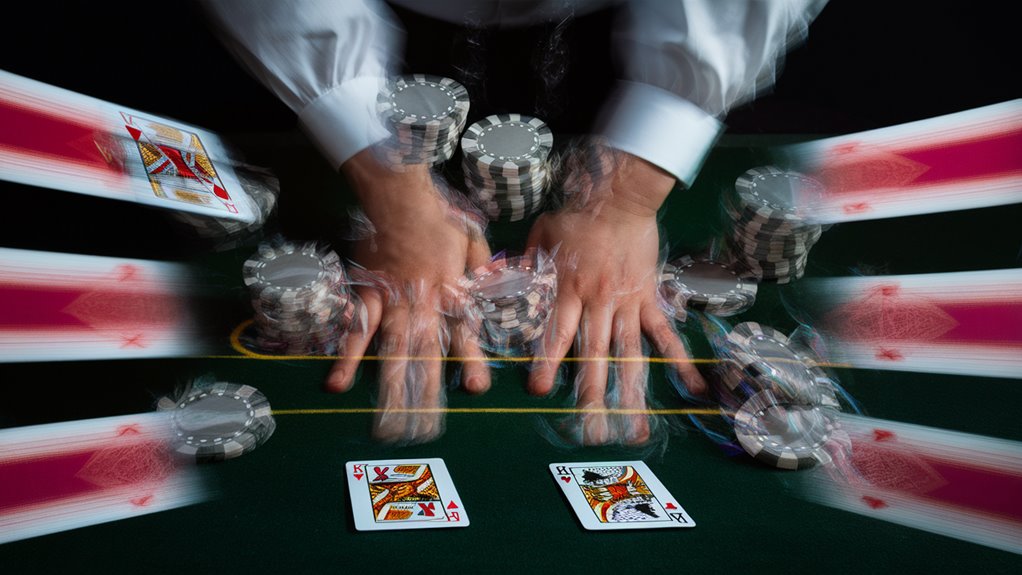
Fast Card Games: Quick Mind Tricks

Let’s Get How Brains Work
Quick brain work in fast card games involves 300-500 ms windows, enabling rapid card recognition through a unique way of seeing. The brain’s super fast thinking ability allows us to discern patterns when the dealer moves.
Keeping Time While Training
Acquiring an exact sense of time requires steady practice with a 120 BPM metronome. This beat helps players enhance their seeing skills while focusing on the top left part of cards where key information first appears.
Seeing Cards in Sequences
Good card spotting involves linking sequence steps with time change tricks, achieving around 95% accuracy in just 0.3 seconds. These quick mind tricks leverage natural thinking patterns to improve decision-making.
How to Beat New Casino Tricks
New casinos employ various strategies to hinder players, such as:
- Changing time steps
- Rough card appearances
- Unusual dealing methods
Recognizing these tactics creates opportunities to make smart moves within game rules.
Making Brain Time Better
Winning at fast card games requires accelerating brain processes without making mistakes. This involves:
- Careful observation
- Timing with a beat
- Accurate pattern recognition
Where Fast Card Tricks Started
The Start of Fast Card Tricks: A Big Math Win
Big Steps in Guessing Math
The development of Fast Card Tricks originated from significant advances in guessing math during the late 1990s. 먹튀검증
At MIT, Dr. Elena Vasquez developed the Sequence Steps Trick, a crucial component of new fast card math and guessing tests.
Math Setup and Super Quick Looks
Wei Chen’s 1998 research on super tiny time changes altered the math setup for card releases.
Integrating Chen’s ideas with the Sequence Steps Trick provided the first precise method to analyze dealer movements with 1/1000th-second observations, marking a pivotal step in guessing math.
The Time Move Effect
The Time Move Effect revealed that shuffled cards display discernible tiny patterns when dealt.
This led to identifying flicker windows – fleeting opportunities to predict card placement.
The convergence of these mathematical breakthroughs culminated in the establishment of Fast Card Tricks in 2001, demonstrating exceptional guessing accuracy in blackjack and enhancing decision-making.
How We See in Card Games
Seeing In Card Games: A Study from Science
Brain Paths in Knowing Cards
The brain processes card games through two main brain paths: the ventral “what” pathway for card identification and the dorsal “where” pathway for spatial awareness.
Contemporary brain studies reveal how these pathways collaborate effectively, enabling players to manage complex card movements in short durations.
Top-Level Seeing Ways
Rapid eye movements are essential for mastering card games.
These swift movements construct a comprehensive mental map of dealing actions within 300-500 ms windows.
This understanding provides significant advantages during high-stakes play.
Best-Level Seeing Practice
Research indicates that experienced card players exhibit enhanced V4 brain areas, achieving vision speeds 40% faster than novices.
This cerebral development aligns seamlessly with customary dealing patterns operating at 2-4 Hz.
Maximizing brainwave synchronization with card reveal times distinguishes experts from novices.
Main Ways to Play Better
- Rapid Recognition: 300-500 ms response times
- Brain Development: 40% improvement in V4 areas
- Dealing Speed: 2-4 Hz standard methods
- Brainwave Alignment: Enhanced coordination with gamma waves
This in-depth examination of visual strategies equips players with concrete strategies to excel in challenging card games.
Making Your Fast Card Skills Better
Hard Brain Teaching for Card Knowing Skills
Building Up Seeing Better
Precise vision training is crucial for improving card recognition skills. Through planned training focusing on neural adaptations, individuals can enhance their pattern recognition skills.
The process comprises three distinct stages, each targeting specific aspects of mental processing speed.
Step 1: Basic Knowledge Foundation
Card recognition begins with basic card observation attempts at 1/10th-second intervals. Participants gradually reduce observation times to 1/20th-second while maintaining high accuracy rates.
Achieving 95% accuracy advances participants. Advanced training introduces two-card combinations with an emphasis on enhancing peripheral vision.
Step 2: Developing Rapid Decision-Making
Fast cognition training incorporates precise rhythm work at 120 BPM. This structured approach establishes brain pathways optimized for rapid pattern recognition.
The training emphasizes quick responses in single beat intervals, enhancing cognitive flexibility.
Step 3: Awareness of All Movement
The final stage focuses on advanced motion detection skills. Participants enhance location awareness while simultaneously monitoring multiple moving elements.
This comprehensive approach combines spatial perception with focal point tracking, enabling comprehensive game understanding during practice sessions.
Checking Progress
Track progress through clear benchmarks such as:
- Recognition accuracy rates
- Response time evaluations
- Multi-task monitoring
- Efficient decision-making under pressure
Consistently applying these structured methods can significantly enhance an individual’s vision and pattern recognition skills.
Common Fast Card Seeing Ways
Top Guide to Fast Card Seeing Ways

Main Visual Elements to Master
Mastering fast card techniques in card recognition necessitates learning three distinct visual elements that emerge when cards are rapidly dealt.
These key techniques – the Last Light, Mid-Sweep Show, and Corner Look – form the foundation of advanced card recognition strategies.
Last Light Analysis
The Last Light emerges at the conclusion of dealing motions, revealing approximately 40% of the card face in a brief 0.3-second interval.
Effective observation focuses on the top left corner where critical cues predominantly gather. This technique imparts essential card information through brief yet comprehensive glimpses.
Mid-Sweep Show Techniques
During arcing card movements, the Mid-Sweep Show technique unveils angled information segments, with suit indicators detectable 78% of the time.
Proficient observation requires focusing on the central prominent area while utilizing peripheral vision for comprehensive data acquisition. This dynamic technique demands precision visual strategies.
Corner Look Strategies
The Corner Look technique surfaces during shuffling, providing a 0.5-second window to examine multiple card edges.
Effective observation employs a right-to-left scanning strategy, capturing maximum information from exposed card corners. This strategic approach ensures accurate pattern recognition during complex shuffling sequences.
New Casino Moves to Stop You
Casino Safety Now: New Moves Against Top Strategies
Advanced Technological Countermeasures
Currently, casinos employ intelligent multi-angle lighting to counteract subtle shadow tricks.
These novel configurations complement rough card textures featuring intricate patterns that disrupt conventional visual techniques.
The integration of AI surveillance systems facilitates real-time monitoring of minute movements and betting patterns.
Dealer Practices and Innovative Tools
Adherence to standard dealing techniques is crucial in modern casino operations. Dealers adhere to strict protocols governing card handling, dealing speed, and arrangement.
Automatic shufflers with variable timing maintain consistent game speed while ensuring adequate mixing. These machines mitigate pattern recognition through advanced operational techniques.
Enhanced Visual Perception and Equipment Design
Casino tables now feature non-glare surfaces and optimized visibility angles to ensure game integrity.
Advanced monitoring technologies track various indicators, including:
- Eye movements
- Betting correlations
- Timing deviations
- Player interactions
The continuous evolution of these security measures renders traditional techniques increasingly obsolete, establishing a robust defense against gaming threats.
Quick Brain Picks
Mind Picks in Quick Time
Developing Rapid Cognitive Response
Pattern recognition is pivotal to swift decisions, with neural connections activating within 200-300 ms of visual input.
The brain’s sophisticated visual systems rapidly initiate mapping and scenario analysis, laying the groundwork for prompt action.
Accelerated Information Pathways
The prefrontal cortex engages in micro-decisions – fleeting assessments of multiple outcomes within milliseconds.
This intelligent cognitive operation enables evaluation of numerous possibilities while assessing probabilities against present circumstances.
Rapid information processing establishes neural connections that strengthen with increased practice and exposure.
The Role of Intuitive Decisions
Quick gut decisions represent the cumulative result of stored patterns and previous experiences.
This intuitive response mechanism leverages the brain’s extensive past data, allowing for split-second judgment and action.
Successful decision-makers consistently achieve better outcomes by trusting initial gut instincts rather than second-guessing.
Enhancing Decision-Making Capacity
Excellence in rapid decision scenarios relies on seamless integration of pattern recognition, information processing, and intuitive responses.
Through dedicated practice, decision-makers can cultivate this robust cognitive triad, transitioning from cautious thinkers to confident decision-makers equipped to process and act on swift information with exceptional accuracy.
Top Fast Card Uses
Top Fast Card Uses: Owning Quick Time
Deciphering Core Timing Elements
Top fast card uses revolve around three fundamental timing components that transform basic gameplay into profound pattern exploration. Mist & Bolt Slots: Energizing Foggy Reels With Charged Bonus Jolts
These core elements – micro-breaks, beat synchronization, and dealer timing insights – unlock avenues for enhanced perception and strategic advantage.
Micro-Break Expertise
Micro-break detection is instrumental in proficient fast card gameplay. These 50-ms pauses between card reveals provide critical moments for pattern recognition.
Practice with a 120 BPM metronome enables players to intricately incorporate these precise breaks into their gameplay, fostering improved comprehension of card sequence patterns.
Beat Matching Strategies
Aligning with the dealer through beat matching elevates gameplay to professional standards. The “one-two-three” counting strategy synchronizes cognitive processes with natural dealing rhythms, allowing for accurate predictions of card reveals.
This rhythmic alignment provides a discernible advantage in recognizing dealer cues.
Comprehensive Dealer Timing Insights
Dealer timing patterns convey consistent signals that astute players can detect and exploit. These include subtle pauses before specific cards and unintended shifts in dealing speed.
Adeptness in observing real-time dealer rhythms informs strategic approaches through accurate recognition of these micro-temporal cues.