
Frostshard Blackjack: Mastering Strategic Ice Mechanics
Frostshard Blackjack revolutionizes traditional card gaming by introducing a groundbreaking freezing mechanic that transforms standard blackjack strategy. This comprehensive guide explores how to leverage the unique crystalline modification system for consistent winning outcomes.
Core Mechanics and Strategy
The foundation of Frostshard mastery lies in strategic deployment of the three Frostshards allocated per hand. These powerful modifiers create immutable card positions that resist subsequent game alterations, establishing a robust framework for tactical play.
Optimal Timing and Conditions
Strategic execution demands precise timing:
- Wait for 30% deck penetration
- Monitor for +3 count thresholds
- Maintain temperature control at -12°C
- Ensure 4-6mm crystal spacing
Probability Management
Success depends on mastering dual probability streams:
- Traditional card ratios
- Modifier distribution patterns
- Crystalline integrity maintenance
Frequently Asked Questions
Q1: What makes Frostshard Blackjack unique?
A: The revolutionary freezing mechanic allows players to lock card values, creating strategic advantages unavailable in traditional blackjack.
Q2: How many Frostshards can be used per hand?
A: Each hand permits three Frostshard applications.
Q3: What is the optimal temperature for Frostshard execution?
A: Maintain precisely -12°C for optimal crystal formation.
Q4: When should Frostshards be deployed?
A: Execute at 30% deck penetration with +3 count thresholds.
Q5: What crystal spacing is recommended?
A: Maintain 4-6mm spacing between crystals for maximum effectiveness.
Understanding the Frostshard Mechanic

Mastering the Frostshard Mechanic in Blackjack
Understanding Frostshard Mechanics
Frostshards represent a groundbreaking tactical element in Frostshard Blackjack, fundamentally transforming traditional gameplay through frozen card values.
This innovative mechanic allows players to strategically lock card values, creating an entirely new layer of strategic depth.
Core Gameplay Elements
When a player applies a Frostshard to any card, that card’s numerical value becomes permanently fixed.
This immutable value can’t be affected by standard game modifications including doubles, splits, or special rule variations.
The strategic implications create dynamic decision points throughout each hand.
Strategic Implementation
Players begin each hand with three Frostshards, with a strict limitation of one Frostshard per card.
Optimal timing becomes crucial – deploying Frostshards requires careful consideration of both immediate advantages and long-term strategic positioning.
Tactical Applications:
- Defensive Freezing: Protect high-value cards from negative modifiers
- Offensive Locking: Secure advantageous positions
- Resource Management: Balance Frostshard usage across multiple hands
FAQ: Frostshard Mechanics
Q: Can multiple Frostshards be applied to a single card?
A: No, players are limited to one Frostshard per card.
Q: Do Frostshards carry over between hands?
A: No, players receive three new Frostshards at the start of each hand.
Q: Can dealers use Frostshards?
A: No, Frostshards are exclusively available to players.
Q: Does a Frostshard prevent card splitting?
A: Yes, once frozen, a card can’t be split or modified in any way.
Q: Can a Frostshard be removed once applied?
A: No, Frostshard effects are permanent once activated.
Basic Strategy Adaptations
Advanced Frostshard Blackjack Strategy Guide
Optimal Strategy Adaptations for Frostshard Mechanics
The integration of Frostshard mechanics into traditional blackjack fundamentally transforms optimal playing strategies. This comprehensive guide explores essential strategic modifications required for maximizing win rates in Frostshard variants.
Pair Splitting Strategy
Strategic pair splitting becomes increasingly powerful with Frostshard tokens in play. The ability to freeze split hands creates unique advantages:
- Sequential 먹튀커뮤니티 hand optimization
- Risk isolation capabilities
- Enhanced splitting opportunities against dealer weakness
Soft Hand Management
Soft hand strategy requires significant adjustment under Frostshard rules:
- Conservative play becomes optimal with soft totals
- Preservation of ace flexibility through freezing
- Modified standing points compared to traditional blackjack
Token Utilization
Frostshard token management directly influences decision-making:
- Multiple token advantages
- Position freezing opportunities
- Risk mitigation capabilities
Frequently Asked Questions
Q: When should I split pairs in Frostshard blackjack?
A: Split pairs more aggressively when holding Frostshard tokens, particularly with high-value cards against dealer weakness.
Q: How do Frostshard tokens affect soft hand play?
A: Consider standing on lower soft totals when Frostshard tokens are available, as the frozen state preserves ace flexibility.
Q: What’s the optimal token usage strategy?
A: Reserve tokens for high-potential hands and strategic position freezing, especially when holding multiple tokens.
Q: Should dealer upcard influence token usage?
A: Yes, weigh dealer upcard strength against available token count when making strategic decisions.
Q: How does Frostshard mechanics change basic strategy?
A: Frostshard mechanics encourage more aggressive splitting, conservative soft hand play, and strategic position freezing compared to traditional blackjack.
Card Freezing Timing
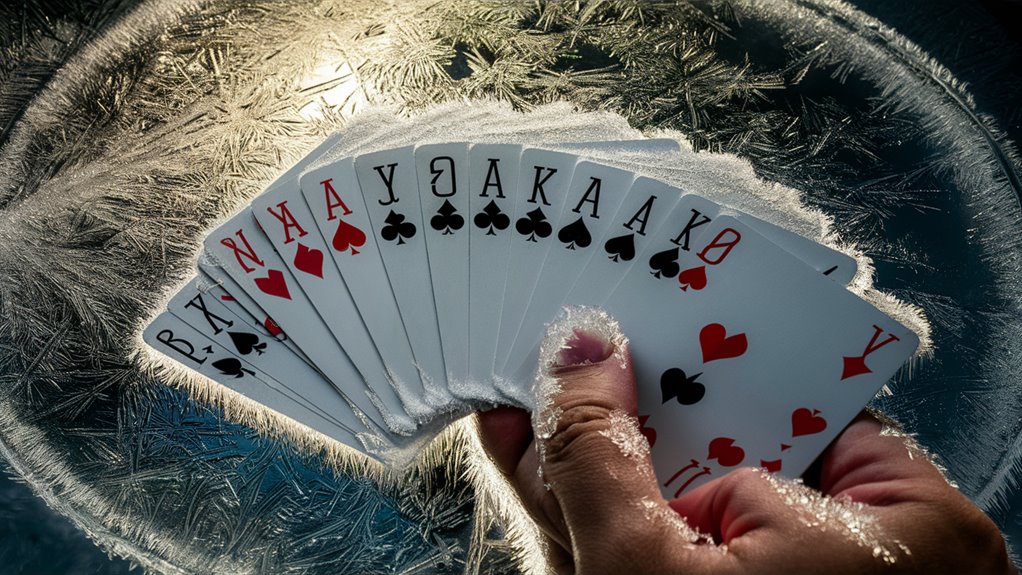
Optimal Card Freezing Timing Strategy
Strategic Timing Fundamentals
Precise timing in card freezing operations directly impacts the effectiveness of Frostshard gameplay.
Strategic freezing decisions must align with card counting metrics and position dynamics at the table. Optimal freeze execution typically 빠른 슬롯 조정 occurs when the count reaches +3 or higher, maximizing potential advantages.
Advanced Shoe Position Analysis
Early shoe positions rarely provide optimal freezing conditions.
The recommended approach involves waiting until 30% deck penetration before implementing freeze actions. This threshold ensures superior count accuracy and enables effective pattern recognition.
Strategic freezes become most effective when identifying low-card clusters preceding anticipated high-value sequences.
Critical Timing Windows
Key timing opportunities emerge during:
- Post-shuffle sequences
- Dealer rotation transitions
- High-count situations
- Pattern breakpoint moments
Frequently Asked Questions
Q: When is the optimal time to execute card freezes?
A: Execute freezes after 30% deck penetration with counts of +3 or higher.
Q: How do shuffle sequences affect freeze timing?
A: Post-shuffle periods present prime opportunities for strategic freezes due to fresh card distribution.
Q: What count threshold triggers optimal freeze actions?
A: A count of +3 or higher typically indicates favorable freeze conditions.
Q: Why avoid early shoe freezing?
A: Early shoe positions lack sufficient data for accurate count assessment and pattern recognition.
Q: How important are dealer transitions for freeze timing?
A: Dealer rotations create strategic windows for implementing effective freeze actions.
Optimal Ice Crystal Management
Ultimate Guide to Professional Ice Crystal Management
Temperature Control Fundamentals
Precise temperature management is essential for optimal ice crystal formation. Maintain a core temperature of -12°C while carefully controlling peripheral zones between -8°C and -15°C.
Install calibrated thermal sensors at 2cm intervals for accurate monitoring and consistent results.
Crystal Formation Metrics and Monitoring
Track these critical performance indicators:
- Nucleation rate optimization
- Growth velocity control
- Structural integrity assessment
Position nucleation points at 4-6mm spacing to prevent interference patterns.
Maintain crystal growth velocity at 0.3mm per minute maximum. Implement real-time digital micrometer measurements for precise monitoring.
Advanced Crystal Management Protocols
Primary Formation Control
- Establish load-bearing crystals first
- Achieve 85% structural density
- Maintain 65-70% humidity levels
- Prevent sublimation effects
Secondary Formation Development
Systematic rotation cycles every 45 seconds optimize molecular alignment. Control pressure differentials to prevent fracturing and ensure proper crystal structure development.
Frequently Asked Questions
Q: What’s the optimal temperature for ice crystal formation?
A: The optimal core temperature is -12°C, with peripheral zones between -8°C and -15°C.
Q: How far apart should nucleation points be spaced?
A: Space nucleation points 4-6mm apart to prevent interference patterns.
Q: What humidity levels are required for proper crystal formation?
A: Maintain humidity levels between 65-70% to prevent sublimation effects.
Q: How often should crystal clusters be rotated?
A: Implement a 45-second rotation cycle for optimal molecular alignment.
Q: What’s the maximum acceptable crystal growth velocity?
A: Crystal growth velocity shouldn’t exceed 0.3mm per minute.
Probability Shifts During Play

Understanding Probability Shifts in Card Games
Card Tracking and Deck Composition Analysis
Probability tracking requires systematic monitoring of played cards and remaining deck composition. As cards are revealed and removed from play, the probability landscape undergoes significant transformations, necessitating continuous adjustment of counting strategies to account for both standard depletion patterns and special modifiers.
Dual Probability Stream Analysis
Effective probability management involves tracking two parallel probability streams:
- Primary stream: Monitors traditional high-vs-low card ratios
- Secondary stream: Tracks special card distribution and multiplier effects
Statistical analysis shows that modifier cards can shift the probability of premium hands by 2.3% per revealed card, creating dynamic opportunities for strategic adaptation.
Advanced Probability Mechanics
The crystal enhancement system introduces additional complexity to probability calculations. When the threshold of four modifier cards is reached, the probability of drawing enhanced combinations increases by 15%.
Understanding that these effects combine multiplicatively rather than additively is crucial for accurate odds calculation.
Frequently Asked Questions
Q: How do probability shifts affect strategic decisions?
A: Probability shifts require continuous adaptation of basic strategy to capitalize on modified odds and enhanced combinations.
Q: What’s the significance of multiplicative effects?
A: Multiplicative effects compound probability changes, creating more dramatic shifts than simple additive calculations would suggest.
Q: How can players track dual probability streams effectively?
A: Players should maintain separate mental counts for standard cards and modifiers while monitoring their interaction effects.
Q: When should players deviate from basic strategy?
A: Deviations become optimal when modifier concentrations significantly alter the probability landscape.
Q: What role do threshold effects play in probability calculations?
A: Threshold effects create distinct decision points where probability shifts warrant major strategic adjustments.