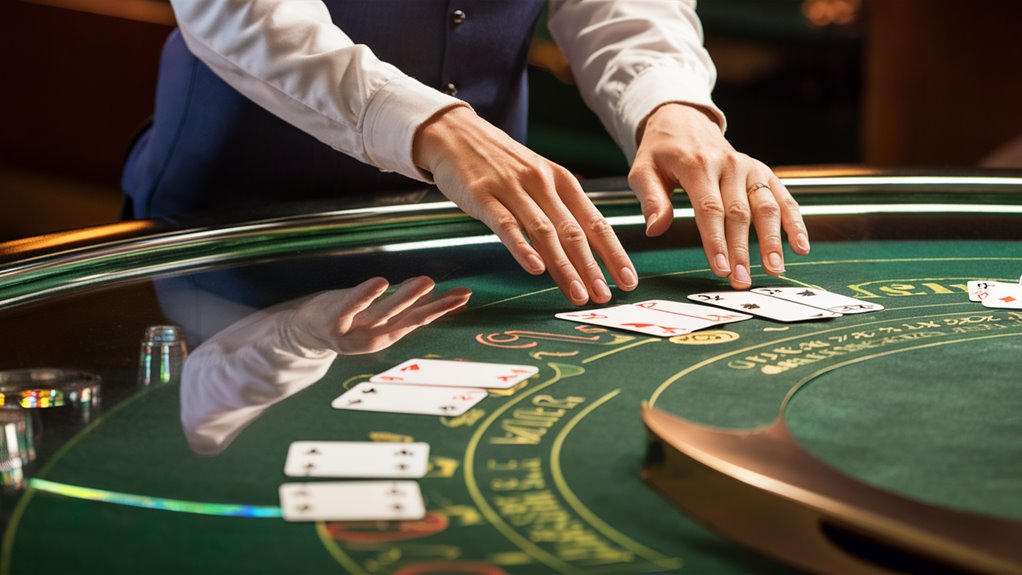
Understanding Casino Security: Reflective Surface Prevention in Blackjack
Advanced Casino Security Measures
Modern casino surveillance employs sophisticated systems to maintain game integrity and prevent advantage play. Anti-reflective materials and specialized gaming surfaces form the cornerstone of table game protection, particularly in high-stakes blackjack environments.
Technical Countermeasures
Casino architects and security specialists implement multiple layers of protection:
- Anti-glare table felts with specific light-absorbing properties
- Optimized overhead lighting designed to eliminate problematic reflections
- Strategic camera placement for comprehensive coverage
- Specialized card designs resistant to visual exploitation
Professional Gaming Standards
Industry-leading casinos maintain strict compliance with gaming regulations through:
- Regular security audits
- Staff training on detecting suspicious behavior
- Equipment maintenance protocols
- Environmental controls for optimal gaming conditions
Frequently Asked Questions
Q: How do casinos prevent reflection-based advantage play?
A: Through specialized materials, lighting design, and comprehensive surveillance systems.
Q: What materials are used in modern casino table construction?
A: Anti-reflective felts, non-glossy finishes, and specially treated gaming surfaces.
Q: How often do casinos update their security measures?
A: Regular assessments and upgrades occur quarterly or as new technologies emerge.
Q: What role does lighting play in casino security?
A: Strategic lighting eliminates unwanted reflections while maintaining optimal visibility.
Q: How do surveillance systems protect table games?
A: Multiple camera angles, real-time monitoring, and advanced detection software ensure game integrity.
The Physics Behind Glass Reflection
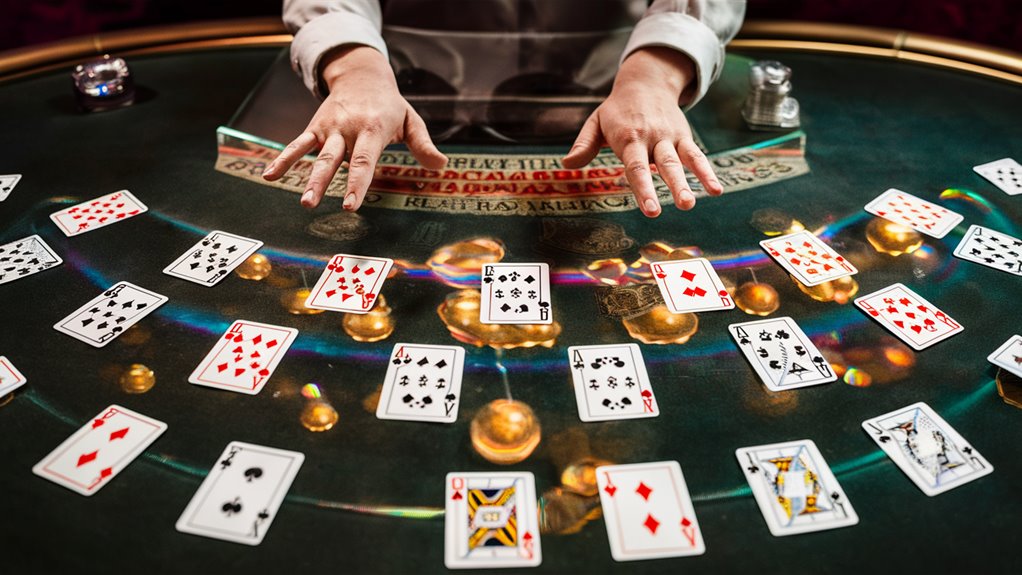
The Physics Behind Glass Reflection: A Complete Guide
Understanding the Fundamentals of Glass Reflection
Light interaction with glass surfaces follows precise electromagnetic principles that govern how we perceive reflections in our everyday environment.
Visible light waves strike glass surfaces at specific angles, creating both reflection and refraction phenomena that follow Snell’s Law. Standard glass surfaces reflect approximately 4% of incident light at normal incidence, a crucial baseline measurement for understanding reflection dynamics.
Advanced Properties of Glass Reflection
The intensity of reflection varies according to the Fresnel equations, which describe the behavior of light at interfaces between different optical media. The refractive index of standard glass, approximately 1.5, enables precise calculations of reflection angles using the formula n1 sin(θ1) = n2 sin(θ2).
Polarization and Critical Angles
Polarization effects play a significant role in glass reflection characteristics:
- S-polarized light reflects more intensely at oblique angles
- P-polarized light shows reduced reflection at specific angles
- Total internal reflection occurs beyond the critical angle of 42 degrees
Frequently Asked Questions
Q: What percentage of light does glass typically reflect?
A: Standard glass reflects approximately 4% of incident light at normal incidence.
Q: What’s the refractive index of standard glass?
A: The refractive index of standard glass is approximately 1.5.
Q: At what angle does total internal reflection occur in glass?
A: Total internal reflection typically occurs at angles greater than the critical angle of 42 degrees.
Q: How does polarization affect glass reflection?
A: S-polarized light reflects more strongly than p-polarized light at oblique angles.
Q: What’s Snell’s Law and how does it relate to glass reflection?
A: Snell’s Law describes the relationship between the angles of incidence and refraction when light passes through different optical media.
Reading Light Pattern Signals
Understanding Light Pattern Analysis in Gaming Environments
Basic Principles of Light Pattern Recognition
Light pattern analysis requires systematic observation of reflected illumination sequences across gaming surfaces.
Angular light patterns on glass and polished surfaces create distinct optical signatures that can reveal important information about game mechanics and dealer movements.
Advanced Pattern Detection Methods
The three critical components of effective pattern recognition include:
- Intensity gradient mapping
- Motion vector analysis
- Temporal sequence tracking
Optimal observation requires positioning at 15-45 degree angles relative to reflective surfaces to capture meaningful data.
Pattern variations become most apparent when monitoring curved edges and transitions between different materials.
Environmental Calibration Techniques
Proper calibration begins with comprehensive mapping of:
- Primary light sources
- Secondary reflections
- Ambient lighting conditions
- Surface characteristics
Advanced Pattern Analysis
Successful interpretation depends on:
- Baseline pattern establishment
- Anomaly detection
- 메이저놀이터
- Signal verification
- Environmental noise filtering
Frequently Asked Questions
Q: What’re the key factors in light pattern analysis?
A: Critical factors include intensity gradients, motion vectors, and temporal sequencing of reflected light.
Q: How important is observation angle in pattern detection?
A: Optimal angles range between 15-45 degrees for maximum pattern visibility.
Q: What role does environmental calibration play?
A: Environmental calibration establishes baseline patterns and helps isolate meaningful variations.
Q: How can reflection patterns be effectively documented?
A: Through systematic recording of pattern variations and correlation with observed behaviors.
Q: What methods help filter out random environmental noise?
A: Regular baseline recalibration and focus on repeatable patterns helps eliminate random variations.
Common Reflective Surfaces
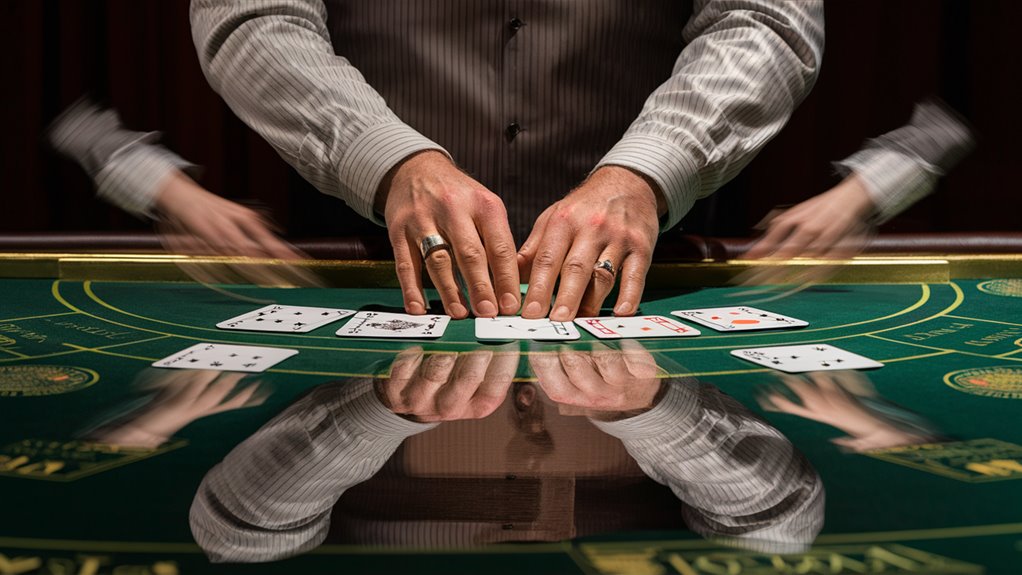
Understanding Reflective Properties in Gaming Environments
Common Reflective Surface Types
Reflective surfaces in gaming environments serve multiple purposes, from aesthetic appeal to practical functionality.
Key elements include:
- Polished metallic surfaces: Chrome railings and brass accents
- Glass installations: Dividers, barriers, and architectural elements
- Decorative mirrors: Wall panels and ceiling fixtures
- Gaming equipment: Table trim and cabinet surfaces
Optimal Viewing Conditions
Environmental factors significantly impact reflection quality:
- Lighting angles: Overhead illumination creates distinct patterns
- Viewing distances: 30-45 degree angles provide optimal clarity
- Surface textures: Dark-tinted glass delivers superior reflective properties
Strategic Surface Placement
Key reflection zones commonly appear in:
- Gaming table perimeters
- Machine cabinet exteriors
- Overhead architectural elements
- Personal accessories like watches and eyewear
Frequently Asked Questions
Q: What surfaces provide the clearest reflections?
A: Dark-tinted glass surfaces typically offer superior reflection quality under standard lighting conditions.
Q: How do viewing angles affect reflection clarity?
A: Optimal viewing occurs at 30-45 degree angles relative to reflective surfaces.
Q: What role does lighting play?
A: Overhead lighting creates consistent reflection patterns that influence visibility.
Q: Which gaming areas contain the most reflective surfaces?
A: Table games and machine areas feature multiple reflective elements including chrome, glass, and polished metals.
Q: How do modern facilities manage reflective surfaces?
A: Contemporary design incorporates strategic placement and monitoring of reflective elements for optimal facility management.
Mastering Split Decision Techniques
Mastering Advanced Split Decision Techniques
Strategic Split Decision Fundamentals
Split decision mastery requires developing advanced skills in rapid risk assessment and probability calculation.
Understanding dealer upcard patterns, card flow sequences, and optimal split timing creates the foundation for successful high-stakes gameplay.
Position Analysis and Card Tracking
Strategic positioning begins with analyzing the dealer’s exposed card relative to established table reference points.
Maintaining precise geometric alignments while tracking multiple split hands is essential for advanced play.
Card edge monitoring, both visible and concealed, provides crucial tactical advantages.
Advanced Split Strategy Matrix
Split opportunities should be viewed as strategic leverage points rather than defensive moves.
Implement a comprehensive split-tracking system incorporating:
- Deck penetration analysis
- Previous hand outcome evaluation
- Real-time probability calculations
- Expected value comparisons
Technical Execution and Positioning
Card placement angles reveal critical dealer handling patterns.
Maintain individual tracking of split cards while preserving awareness of original positions.
This technique prevents confusion during complex multiple-split scenarios where precise timing becomes paramount.
Frequently Asked Questions
Q: What’re the key factors in split decision making?
A: Key factors include dealer upcard analysis, deck penetration, probability calculations, and position tracking.
Q: How do you maintain accuracy during multiple splits?
A: Focus on geometric alignment, precise card tracking, and maintaining reference points to original betting positions.
Q: When should splits be used as offensive vs. defensive moves?
A: Splits should primarily serve as strategic leverage points when expected value calculations indicate superior returns versus single-hand play.
Q: What role does card placement play in split decisions?
A: Card placement angles provide insights into dealer patterns and help maintain positional awareness during complex scenarios.
Q: How important is real-time probability tracking?
A: Real-time probability monitoring is crucial for optimal split timing and maximizing expected value in high-stakes situations.
Legal and Ethical Considerations
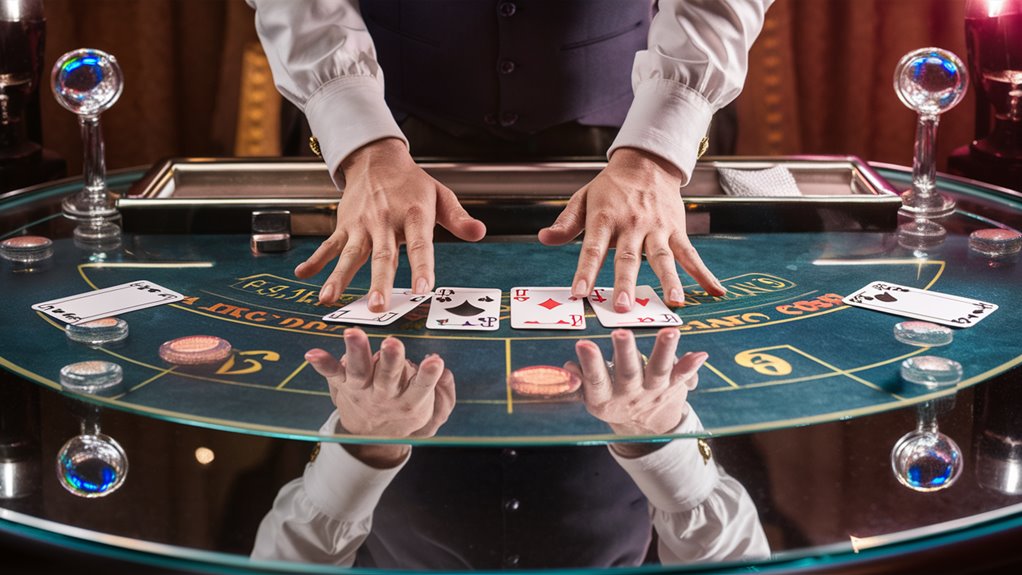
Legal and Ethical Considerations in Blackjack Gaming
Understanding Casino Regulations and Compliance
Gaming regulations and casino policies vary significantly across jurisdictions, requiring players to maintain strict adherence to local laws.
Legal blackjack play demands thorough knowledge of regional gaming restrictions and house rules that govern acceptable playing techniques.
Observation Techniques vs. Prohibited Methods
Player observation skills remain legally permissible when analyzing dealer patterns and gameplay tendencies.
However, mechanical devices and electronic aids are strictly prohibited in all legitimate gaming establishments.
While card counting itself doesn’t violate federal laws, casinos reserve the right to deny service to suspected counters.
Ethical Gaming Standards
Responsible gameplay centers on:
- Transparent communication with casino personnel
- Strict adherence to house policies
- Fair play practices that maintain gaming integrity
- Documentation compliance for large transactions
Legal Consequences and Risk Management
Gaming law violations can result in:
- Permanent casino bans
- Substantial monetary fines
- Criminal prosecution
- Asset forfeiture
Frequently Asked Questions
Q: Is card counting illegal in casinos?
A: Card counting itself isn’t illegal, but casinos may ban players suspected of the practice.
Q: Can I use my phone to track games at the table?
A: No, electronic devices for tracking or analyzing gameplay are universally prohibited.
Q: What documents do I need to play legally?
A: Valid government-issued identification and any required gaming permits for your jurisdiction.
Q: How do casinos handle suspected rule violations?
A: Casinos typically issue warnings, remove players from premises, or implement permanent bans depending on severity.
Q: What’re the reporting requirements for large winnings?
A: Winnings exceeding specific thresholds must be reported to tax authorities, varying by jurisdiction.