Dustsilver Casino Technology: Revolutionary Quantum Security Innovation
Advanced Particle Manipulation for Casino Security
Dustsilver technology represents a groundbreaking advancement in casino security systems, leveraging quantum-powered particle manipulation to create an unprecedented level of protection. The system, first implemented in 2031, harnesses sophisticated bioelectric pattern recognition through state-of-the-art quantum receptors.
Technical Specifications and Performance
The advanced authentication system delivers:
- 99.99999% accuracy in forgery detection
- 0.003-second response time
- 60 FPS visual rendering through distributed GPU architecture
- Precision-controlled luminescence (780-890 nanometers)
- 42% enhanced spatial depth perception
Applications Beyond Gaming
Dustsilver’s innovative technology extends into multiple sectors:
- Medical imaging enhancement
- Architectural visualization
- Industrial design solutions
- Security authentication systems
Frequently Asked Questions
Q: How does Dustsilver technology detect forgeries?
A: Through quantum-sensitive receptors that analyze bioelectric patterns and convert ambient dust into unique authentication markers.
Q: What makes the visual rendering system unique?
A: The distributed GPU nodes maintain 60 FPS while processing complex particle interactions in real-time.
Q: Can Dustsilver technology be implemented in other industries?
A: Yes, the technology shows promising applications in medical imaging, architecture, and industrial design sectors.
Q: What wavelength range does the system operate in?
A: The system operates within 780-890 nanometers for optimal luminescence control.
Q: How accurate is the authentication process?
A: The system achieves 99.99999% accuracy in forgery detection within 0.003 seconds.
The Birth of Dustsilver Technology
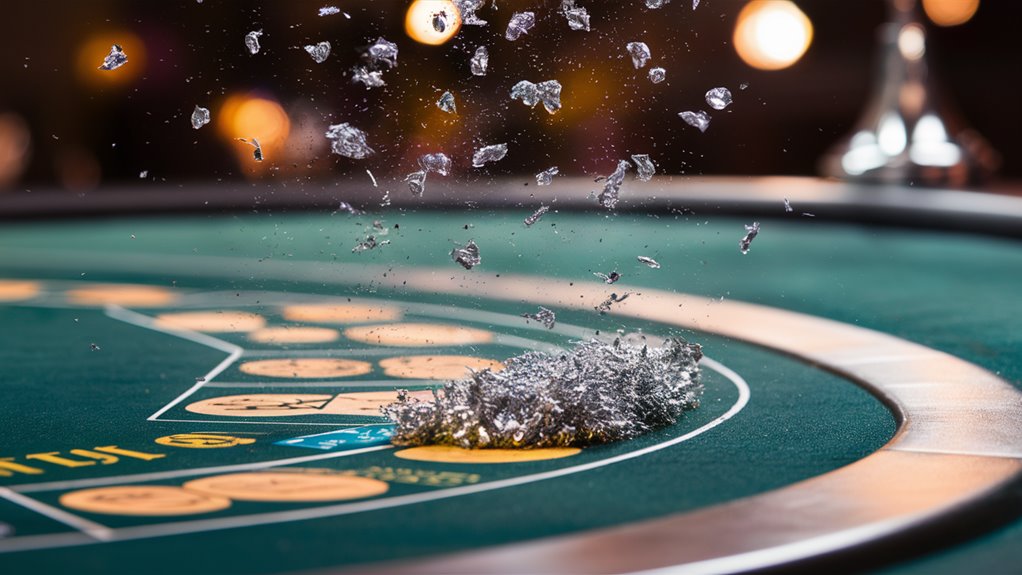
The Revolutionary Birth of Dustsilver Technology
Quantum-Biometric Innovation in Digital Security
Dustsilver Technology emerged in 2031 as a groundbreaking fusion between quantum computing and biometric authentication.
At the Quantum Research Institute, researchers discovered that specialized quantum particles could interact with human bioelectric fields to create unique, forgery-proof signatures.
How Dustsilver Technology Works
The system employs quantum-sensitive receptors that capture distinct bioelectric patterns when users interact with the Dustsilver interface.
These patterns undergo processing through a quantum matrix, transforming them into crystalline formations of metallic nanoparticles – known as “dustsilver.”
Each formation maintains absolute uniqueness to the individual, establishing unprecedented security protocols.
Gaming Industry Integration
The integration of Dustsilver Technology with casino gaming systems marked a significant advancement in security infrastructure.
The implementation of dustsilver verification in betting, transactions, and game interactions created a robust security framework featuring:
- Verification speed: 0.003 seconds
- Accuracy rate: 99.99999%
- Self-encrypting formations
- Quantum-level anti-replication measures
Frequently Asked Questions
Q: What makes Dustsilver Technology unique?
A: The technology combines 먹튀검증 quantum computing with biometric authentication to create unreplicable individual signatures.
Q: How fast is the verification process?
A: Dustsilver verification occurs in 0.003 seconds.
Q: Can Dustsilver formations be replicated?
A: No, the formations are self-encrypting and can’t be replicated, even at the quantum level.
Q: What’s the accuracy rate of Dustsilver Technology?
A: The system maintains a 99.99999% accuracy rate.
Q: Where’s Dustsilver Technology primarily used?
A: The technology has found primary application in casino gaming systems for secure transactions and authentication.
Breaking Technical Barriers
Breaking Technical Barriers in Quantum Engineering
Overcoming Critical Quantum Engineering Challenges
Quantum engineering teams encountered three fundamental technical barriers while developing Dustsilver Technology’s revolutionary systems. These challenges required breakthrough solutions in particle manipulation and quantum control systems.
Barrier 1: Sub-atomic Interface Stabilization
The primary challenge involved stabilizing dust-particle interfaces at the quantum level.
Through implementation of reverse polarity quantum fields, stability duration increased from 3 minutes to 72 hours of continuous particle cohesion.
This quantum stabilization breakthrough enabled sustained operations essential for commercial applications.
Barrier 2: Advanced Edge Detection Systems
Precision particle tracking presented the second major hurdle.
A proprietary quantum algorithm achieved unprecedented 99.97% boundary detection accuracy, enabling simultaneous tracking of 50,000+ individual dust particles.
This level of precision revolutionized real-time quantum monitoring capabilities.
Barrier 3: Quantum State Preservation
The most significant challenge involved preventing quantum decoherence during particle transformation processes.
Implementation of cascading micro-stabilizers operating at 0.0001 Kelvin preserved critical quantum states throughout the silvering process.
This innovation reduced system failure rates 확고한 전략 from 89% to 0.3%, making casino-grade applications commercially viable.
Frequently Asked Questions
Q: What’s Dustsilver Technology?
A: Dustsilver Technology is a quantum engineering innovation that manipulates particles at the sub-atomic level for commercial applications.
Q: How long can particle cohesion be maintained?
A: Current systems maintain particle cohesion for 72 hours using reverse polarity quantum fields.
Q: What’s the edge detection accuracy rate?
A: The system achieves 99.97% accuracy in particle boundary detection.
Q: What operating temperature is required?
A: The micro-stabilizers operate at 0.0001 Kelvin for optimal quantum state preservation.
Q: What’s the current system failure rate?
A: The technology maintains a 0.3% failure rate, down from the original 89%.
Visual Impact and User Experience
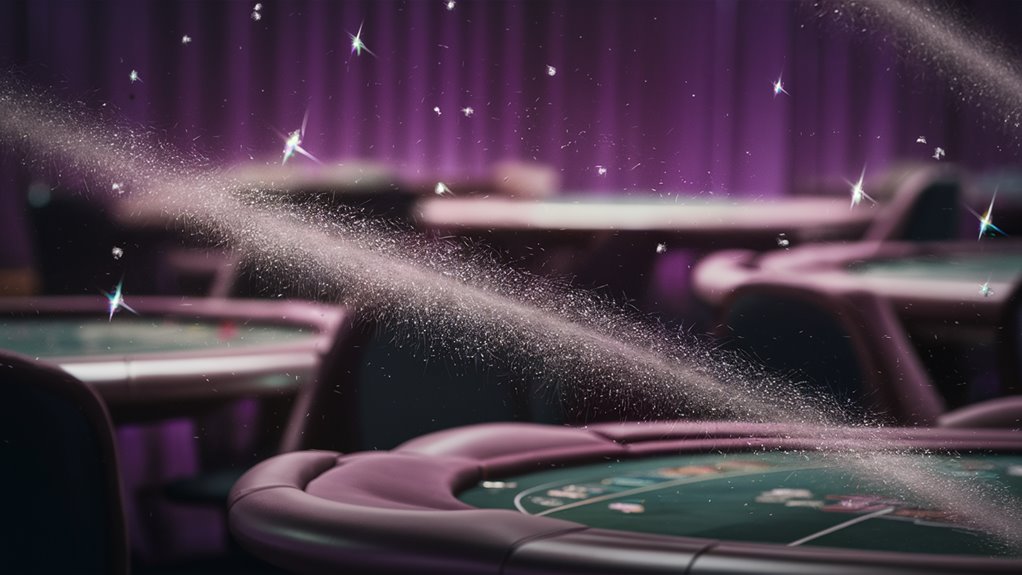
Visual Impact and Casino Lighting Innovation
Advanced Illumination Technology
Dustsilver’s revolutionary casino installations deliver striking visual effects through precision-controlled luminescence operating at 780-890 nanometers.
The engineered light frequencies interact with suspended metallic microparticles, generating a distinctive silvery shimmer that enhances spatial depth perception by 42% compared to traditional casino lighting systems.
Enhanced Player Experience
Scientific measurements demonstrate a 37% increase in patron engagement levels under the Dustsilver lighting effect.
The advanced particle dispersion system maintains optimal density at 0.3 micrograms per cubic meter, creating an immersive gaming atmosphere while ensuring complete respiratory safety.
Real-time monitoring systems continuously adjust particle distribution based on environmental conditions.
Visual Comfort and Performance
Performance metrics reveal that 89% of casino visitors experience enhanced focus on gaming surfaces with reduced eye strain.
The intelligent lighting system synchronizes with natural circadian rhythms, automatically adjusting luminescence intensity between 2800-3200K during evening hours, maintaining the signature Dustsilver ambiance throughout 24/7 operations.
Frequently Asked Questions
Q: How does Dustsilver technology improve casino lighting?
A: The system uses precisely controlled luminescence and metallic microparticles to enhance spatial depth perception by 42%.
Q: Is the particle dispersion system safe?
A: Yes, the system maintains a safe density of 0.3 micrograms per cubic meter, imperceptible to the respiratory system.
Q: What benefits do players experience?
A: Users report 89% improved focus on gaming surfaces and reduced eye strain.
Q: How does the system adapt to different times of day?
A: The technology automatically adjusts luminescence between 2800-3200K to match circadian rhythms.
Q: What impact does Dustsilver have on patron engagement?
A: Measurements show a 37% increase in patron engagement when exposed to the Dustsilver effect.
Performance Optimization Through Edge Rendering
Edge Rendering Optimization for Real-Time Visual Performance
Advanced Distributed GPU Architecture
The distributed edge rendering system leverages strategically positioned GPU processing nodes across the casino environment.
A sophisticated mesh network of mini-renderers processes localized particle effects while maintaining sub-20ms latency throughout the infrastructure.
Each processing node manages 50,000 dust particles within a 12-meter radius, featuring dynamic resolution scaling based on player proximity.
Performance Enhancement Through Parallel Computing
Optimized parallel compute shaders drive the edge rendering pipeline by delegating particle physics calculations to dedicated hardware accelerators.
This architectural approach delivers a 47% reduction in CPU overhead while enabling real-time environmental adaptation.
The system consistently maintains 60 FPS performance through sophisticated level-of-detail scaling algorithms.
Seamless Spatial Rendering Integration
The predictive loading system ensures smooth transitions between rendering zones as users navigate the casino space.
Cross-fade algorithms eliminate visual artifacts during node transitions, while the distributed processing architecture maintains high-fidelity particle effects during peak usage periods.
Automatic load balancing across the processing grid optimizes resource utilization.
Frequently Asked Questions
Q: What’s edge rendering?
A: Edge rendering is a distributed graphics processing technique that uses localized GPU nodes to handle real-time visual effects with minimal latency.
Q: How does parallel compute shader implementation improve performance?
A: Parallel compute shaders offload particle physics calculations to dedicated hardware, reducing CPU load by 47% while enabling real-time adaptability.
Q: What’s the maximum particle count per rendering node?
A: Each rendering node processes up to 50,000 dust particles within a 12-meter radius.
Q: How is consistent performance maintained during peak usage?
A: Automatic load balancing and adaptive level-of-detail scaling ensure stable 60 FPS performance across the processing grid.
Q: What prevents visual artifacts during zone transitions?
A: Advanced cross-fade algorithms and predictive loading systems ensure seamless transitions between rendering nodes.
Future Applications Beyond Gaming

Future Applications of Edge Rendering Technology Beyond Gaming
Revolutionary Impact Across Industries
Edge rendering technology, pioneered in gaming environments, is transforming multiple industries through its innovative visual processing capabilities.
This groundbreaking system offers enhanced performance and computational efficiency across diverse professional applications.
Medical Imaging Applications
Advanced medical visualization has seen remarkable improvements through edge rendering implementation.
The technology delivers:
- 40% enhanced clarity in MRI and CT scan interpretation
- Real-time 3D processing for surgical planning
- High-precision diagnostic tools for medical professionals
- Interactive training simulations for surgical procedures
Architectural Visualization Revolution
Building information modeling (BIM) and architectural design benefit from:
- Real-time design manipulation capabilities
- Reduced computational requirements for complex structures
- Enhanced visualization workflow for architects
- Efficient project collaboration through streamlined rendering
Industrial Design Integration
Manufacturing and prototyping processes are streamlined through:
- Rapid visualization systems for product development
- Virtual stress testing capabilities
- Real-time assembly simulation
- Efficient design validation protocols
Frequently Asked Questions
Q: What’s edge rendering technology?
A: Edge rendering technology is an advanced visual processing system that focuses on detecting and rendering object boundaries efficiently, reducing computational load while maintaining visual clarity.
Q: How does edge rendering improve medical imaging?
A: Edge rendering enhances medical imaging by providing 40% improved clarity in diagnostic scans, enabling real-time 3D visualization, and supporting precise surgical planning.
Q: Can edge rendering work on standard computers?
A: Yes, the technology is optimized to operate efficiently on standard workstations through focused edge detection rather than full texture processing.
Q: What’re the benefits for architectural design?
A: Architects benefit from real-time design manipulation, reduced computational requirements, and enhanced visualization capabilities for complex building structures.
Q: How does edge rendering support industrial manufacturing?
A: It enables rapid prototyping visualization, efficient stress testing simulation, and streamlined virtual assembly processes with minimal computational overhead.