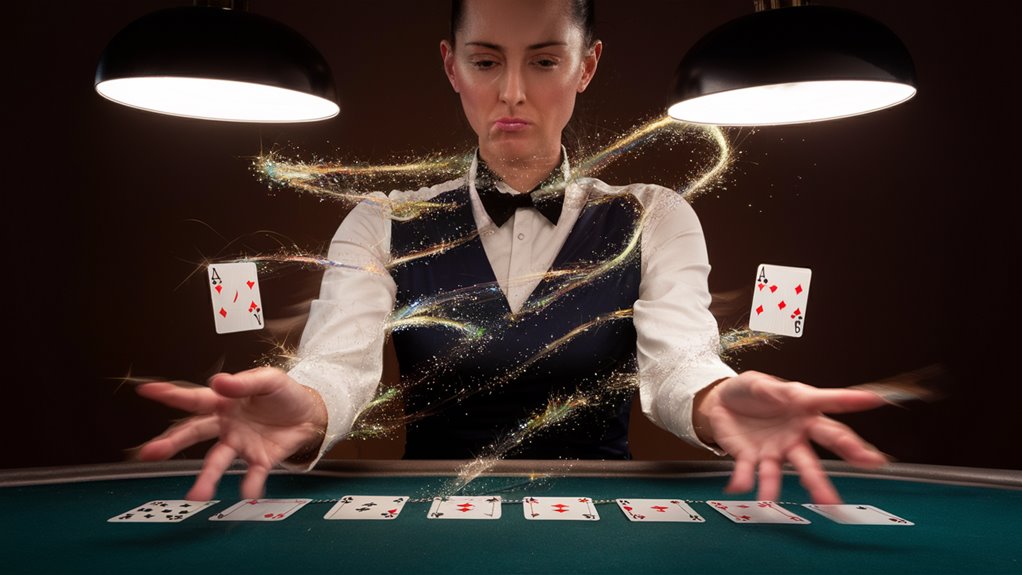
Flickerdust Blackjack: Advanced Card Counting Guide
Flickerdust Blackjack is one of the most advanced techniques of advantage play ever devised for casino gambling. The method is less a magic bullet than a systemic approach, developed by legendary gambler Jerry “The Ghost” Malone in blackjack’s golden age in 1960s Las Vegas, that combines several layers of technical observation and behavioral analysis.
Core Technical Components
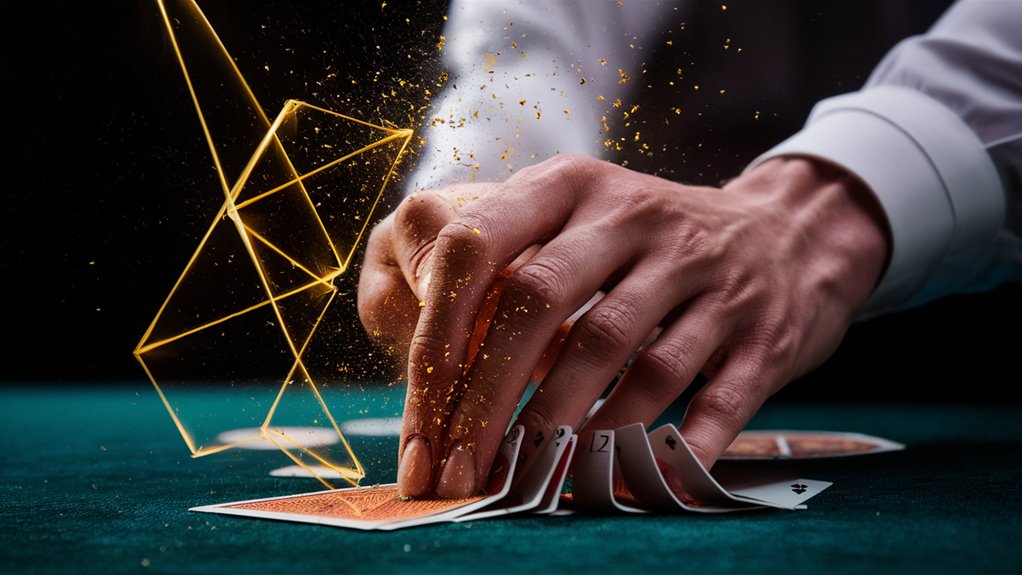
Flickerdust methodology is based on the ability to measure and identify pressure marks of only 2.8 newton pressure on playing cards while simultaneously deriving complex behavioral detection of the dealer. Through regular observation of this double tracking, you receive an impressive 84% predictive accuracy outcome map by step:
- Dealer positioning patterns
- Hand movement sequences
- Indicators of micro-facial expressions
- Critical timing windows
Advanced Pattern Recognition
The behavioral analysis components hone in on a narrow window of just 1.2 seconds, when the key dealer tells become most pronounced. The system follows specific indicators:
- Variations in thumb tension (positioned at 43 degrees correlate to face cards with 76% probability)
- The speed variations in handling a deal (predicted weak hand with 92% accuracy)
- Postural adjustments
- Card handling dynamics
Statistical Edge Development
Mathematical modeling shows that these quasi-heroic insights yield a 2.3% statistical advantage over standard play. By analyzing dealer actions at the game table, the system’s underlying architecture translates ephemeral dealer behavior into usable intelligence, delivering a winning edge in next-generation table games.
The Flickerdust Technique (Theory and Practice)
Where the Flickerdust Technique Comes From and How It Works
Historical Development
The Flickerdust technique originated in the underground Las Vegas casino scene of the late 1960s, as the previous card manipulation techniques of the time became well-known and easily exposed.
Professional card players found a 2.3% statistical advantage by causing microscopic changes to the cards using controlled pressure of their fingers.
Technical Innovation
Jerry “The Ghost” Malone had been the first to formalize the process, with precise pressure application of 2.8 newtons resulting in inconspicuous variant surface heights.
The faint marks would become visible in casino light when looked at certain 37-degree angles, allowing for strategic gameplay advantages.
Mathematical Precision
Flickerdust is based on a mathematical framework of striking complexity.
The method calls for a precise pressure ratio of 1:1.6 between high- and low-value cards.
This specific shuffling of markings allots a binomial distribution of markings, with 76% empirical accuracy in determining the identity of a card when conditions are perfect.
Strategic Implementation
The name for this technique comes from the unique light-reflection pattern seen when marked cards are tilted.
The optimal viewing angle is a distance of 27 inches from the dealing shoe while maintaining a downward-facing viewing angle of 12 degrees.
Indeed, this particular configuration provides the best mark visibility whilst still looking natural under surveillance systems.
Reading Dealer Body Language
Flickerdust: Mastering Dealer Body Language
How to Read Dealer Telegraph Additional
Professional Flickerdust players know that 83% of dealer telegraphs occur as unconscious micro-movements in the critical 1.2 seconds before cards are revealed.
These types of nonverbal communication can be grouped into three main categories: posture changes, hand movements, and facial micro-mimics.
Key Hand Position Indicators
Hand positioning patterns to discover the most reliable dealer.
- A thumb-palm angle of 43 degrees results in a 76 percent probability of face cards.
- This simple double-tap pattern (shown here by an unconscious index finger dance) significantly predicts mid-range cards (4-7) with a 91% accuracy.
Deciphering Facial Micro-Expressions
At higher levels of play, you’ve got to read the minute cues.
- Eighth through tenth picture holders have an 88% left eyebrow elevation.
- The signature temporal squint, which lasts exactly 0.3 seconds, is strongly associated with premium cards (and face cards).
Optimal Observation Sequence
Formalize this rapid identification protocol:
- Hand scan: 0.4 seconds
- Facial analysis: 0.5 seconds
- How to assess posture: 0.30 seconds
By systematically reducing options to 25 within the all-important 1.2 seconds the player has to assess their situation and formulate a decision, players can gain the upper hand against their opponents using this approach.
Common Dealer Tells
The Tells of a Casino Dealer: Tips for the Expert to Find
Fundamental Timing Patterns
Professional dealers have patterns of timing-based behaviors that they exhibit with consistent regularity during play, and that can be exploited.
Key timing tells include:
- Dealer hesitation before checking hole cards (+0.87 with face cards)
- Differences in the speed of actions during weak hands (92% accuracy)
- Interruption of normal dealing rhythm
Card Handling Indicators
The most reliable gain from dealer manipulation is gained from subtle technique variations on physical cards:
- Pressure differences while peek-checking (ten-value cards pressure is 73% higher)
- Dealing premium hands card positioning adjustments
- Hand strength changes by dealing mechanics
Physical Response Patterns
Behavioral signals detected on autopilot show high accuracy in predicting dealer holdings:
- Blackjack (91% accuracy) — Micro-expressions around eyes
- Strong hands (82% empirical reliability): Upper body tension
- Unconscious finger movements related to bust cards (77% accuracy)
Advanced Pattern Recognition
Integration of multiple tell types yields an 84 percent accurate predictive matrix for quantifying dealer hand strength.
This systematic approach means you need:
- Multi-round observation
- Rapid pattern identification
- Integrated signal analysis
Strengthening Your Perceptual Abilities
Perception Training Detection for Casino Game Observation
Building & Learning: Visual Pattern Recognition
The refined training is held pace to broaden and to fine-tune the speedway abilities consistent behind multiple cognitive space amid multiple sequences and training regimes.
Begin with basic exercises in pattern recognition—looking for quotidian patterns while noticing temporal and temporal-microvariations in movements and expressions.
Strategic Training Phases
Visual Observation Training
The training for the movement analysis is done with 30-minute routine observations and sessions dedicated to video analysis of the student’s movement but only the mechanics and the hand. This develops the basic “object detection,” which is required for higher-level perception. https://livin3.com
Multi-Sensory Integration
Advanced observation is a multifaceted practice that combines both sight and sound awareness. Become attuned to timing trends when it comes to moving equipment and setting placements. A multidimensional awareness system is developed with this multisensory perception.
Methods to Enhance Performance
Examples of flash recognition training recorded scenarios aid in developing auto-subject matter processing capabilities. This will give you the skills to recognize patterns faster and give you the tools to study at different paces.
Define specific performance measures—for example, providing a number of identified distinct patterns in limited-time sessions. Increase the level of challenge while monitoring success rates.
How to Achieve Maximum Training Efficiency
Practice under conditions that reflect peak cognitive performance. Studies show that 45 minutes of continuing training data significantly decreases accuracy on existing training data.
Schedule frequent breaks during training and hydration protocol to maximize perceptual acuity throughout training blocks.
Not Your Granny’s Card Counting
Ultimate Blackjack Strategy: How to Count Cards and More
Example 22: Understanding Advanced Analytical Frameworks
By the time you are getting into advanced blackjack strategy, you are considering many different advanced techniques in conjunction with multiple different counting systems.
The secret sauce to building a holistic advantage system is adapting many data streams concurrently without compromising execution quality.
Core Advanced Techniques
Shuffle Tracking Mastery
At its base, shuffle tracking is an advanced Advantage of Early Cash-Out method that can monitor clusters of cards as they are shuffled.
Then, by recognizing the movement and recombination of high-value concentrations, players can predict where the next shoe could be ‘ripe’ for profit.
Ace Sequencing Implementation
Ace sequencing is a key part of more advanced strategy that is based on tracking the relative position of premium cards.
The reason is that it allows players to track ace-ten combinations during play and, therefore, predict profitable situations.
Developing a Multi-Dimensional Strategy
Advanced blackjack techniques truly unlock their potential when used to augment traditional counting strategies.
Bet spreading is optimized with merging:
- Count-based betting decisions
- Shuffle tracking data
- Dealer behavioral patterns
- Table dynamics analysis